Newton's 3rd law
JJ Bird, Octavio Avilan Garcia, and Elias Leino
Welcome to our project on Newton's third law! Our project explores how all forces have an equal and opposite force, meaning when an object pushes, pulls, or puts force on another object, the second object pushes or pulls back with that same force. Our project is guided by interactive demos showcasing realistic scenarios, showcasing the law with visuals. This is the law that makes anything from walking, to swimming or rockets work.
Definition
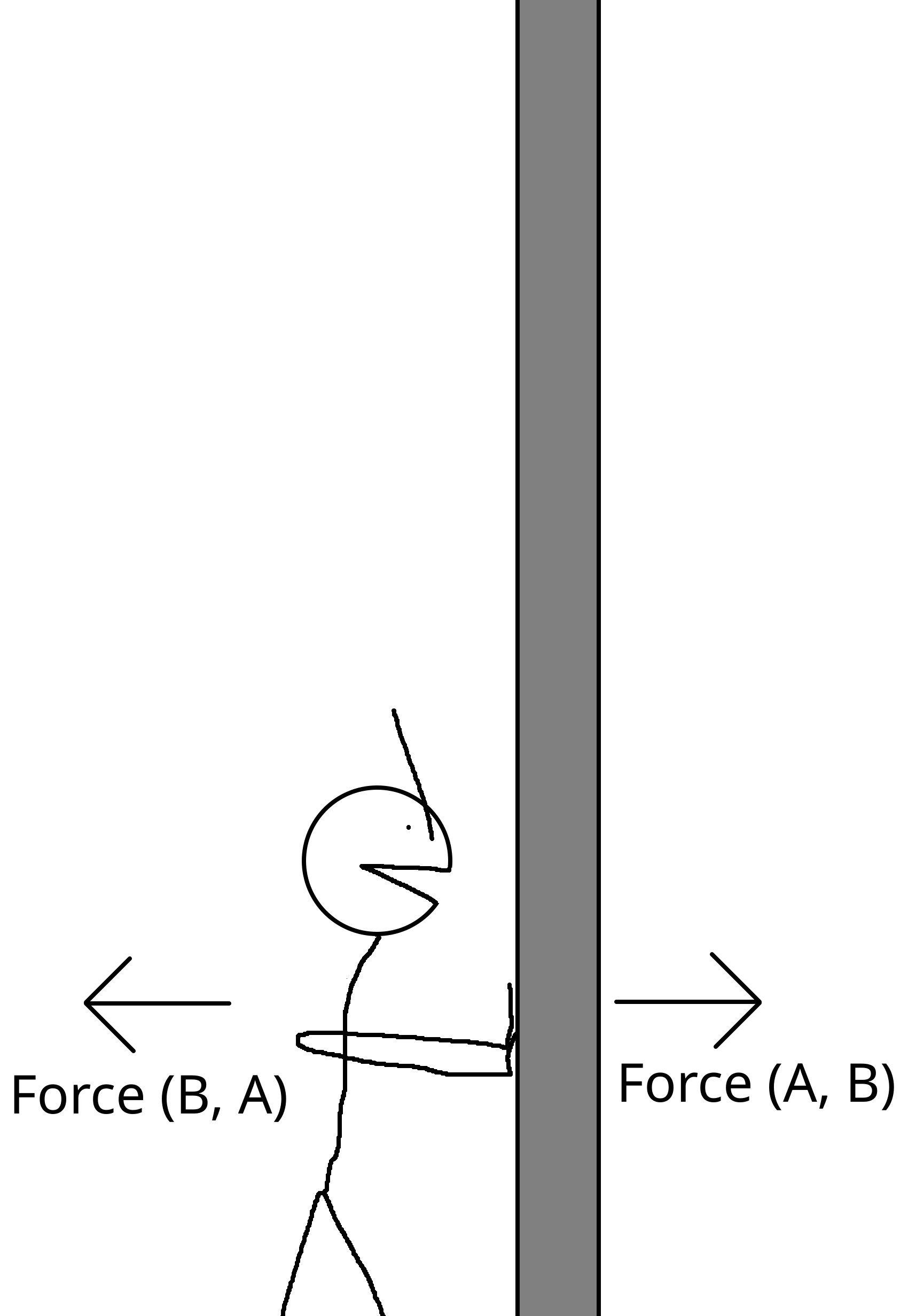
Newton’s third Law states that for every action, there is an equal and opposite reaction. This means that when an object puts a force into a second object, the second object puts that same amount of force into the first object. Try shoving your arms against a wall; the wall might not move, but you'll feel it shoving back. You'll probably also end up stumbling backwards, even though you're the one pushing on the wall; the wall is pushing right back at you with the same force. Friction and weight also affect movement, as when two objects physically interact, the one with less friction and weight will usually move more, despite the forces being equal. This law is about Action & Reaction, and how forces always come in pairs.
Equation and momentum
This is the equation that expresses Newton’s Third Law for the forces two objects apply to one another:
The equation may look intimidating at first, but it is simple. F is the force, and A and B are the two objects in the system. The force on object B due to object A (FA,B) is equal in magnitude and opposite in direction to the force on object A due to object B (−FB,A). Keep in mind that force is not momentum, though they are closely related: a force is the push or pull that changes momentum, and the resulting momenta of the two objects are equal in magnitude and opposite in direction.
Momentum for a single object is calculated by:
Where "p" is momentum, "m" is mass, and "v" is velocity. When an object applies a force to another object, the two calculations for their momentum must be equal, due to the equal forces applied on both objects.
This demo shows a spaceman applying a force to a satellite. Notice that the spaceman and satellite get pushed in opposite directions; this is because an equal and opposite force is getting applied to both objects. In space, there's no friction, so both objects move away slowly. Changing the push strength of the spaceman or the mass of the satellite affect their respective velocities moving away from each other, but their momentum, calculated by multiplying velocity x mass, is always equal, and in opposite directions. Notice how when the satellite and person weigh the same, they move at the same velocity. Try changing their momentum values and see what happens!
About Sir Isaac Newton
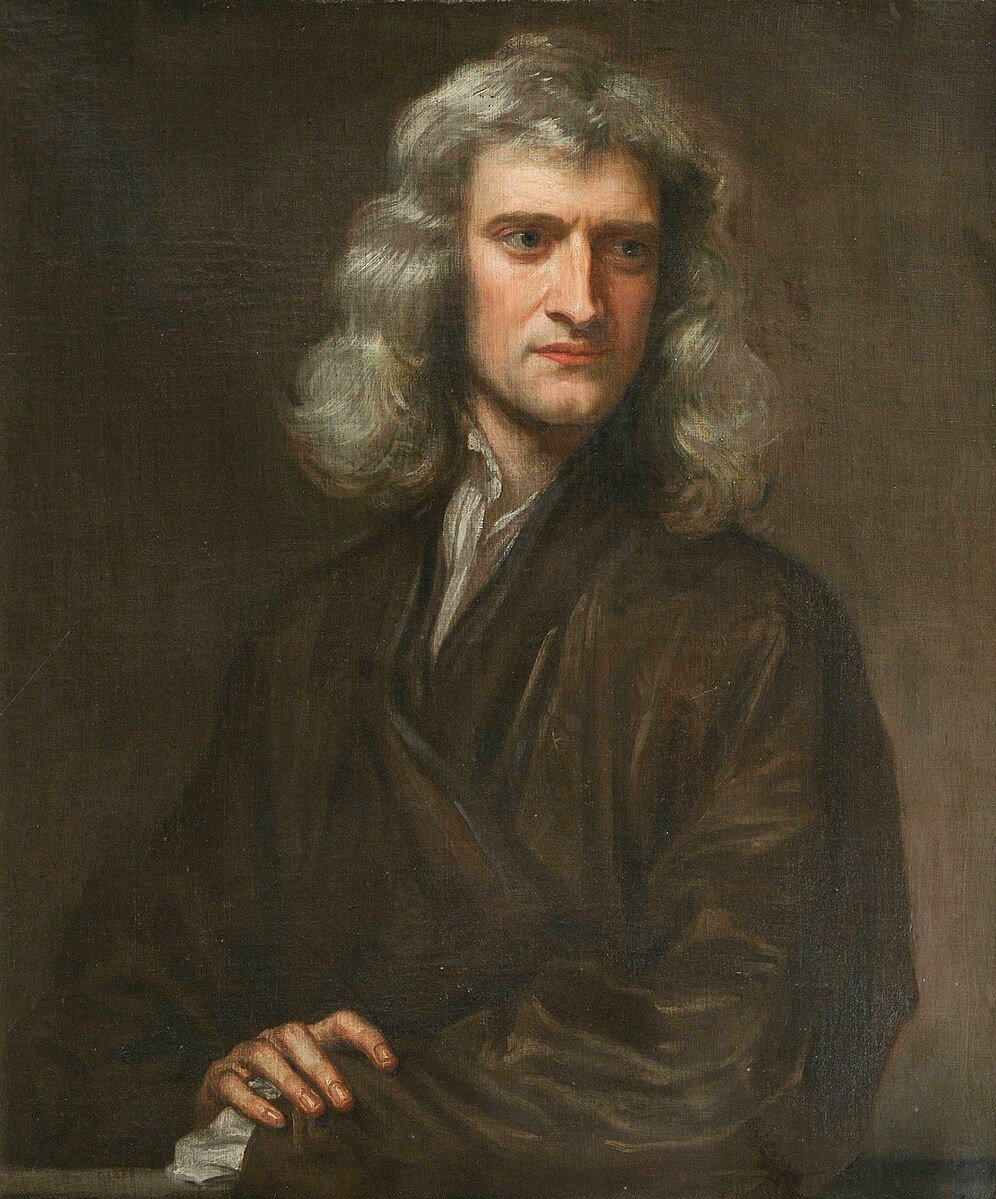
Born in 1643, Sir Isaac Newton was an English physicist, mathematician, and astronomer who is now credited as one of the great minds of the 17th century scientific revolution. He is referred to as "Sir" Isaac Newton, as he was knighted in 1705 by Queen Anne of England. In his early life, Newton was enrolled in the King's School in Grantham, where he discovered his love for chemistry. When the Bubonic Plague hit Europe and Cambridge University closed from 1655-1666, Newton took this time to develop ideas and experiment with motion and math, leading to his famous works in physics. It was during this time period that an apple fell from a tree and landed on Newton, leading to him thinking about why objects fall towards the earth.
Discovery
In the mid 17th century, Isaac Newton was piecing together ideas from multiple different scientists from the time, such as Christiaan Huygens, Christopher Wren, and John Wallis. He was studying collisions, and how important actions and reactions are. Newton looked further into these two topics, noticing and paying attention to symmetry in nature, and how forces always appear in pairs, equal and opposite to each other. Also, interactions involve equal and opposite responses. In 1687, he published his findings to Philosophiæ Naturalis Principia Mathematica. Newton's third law became a foundation for classical mechanics, influencing physics and engineering deeply.
This demo shows a realistic example of the third law on land. Think about what would happen if you threw a ball while standing on a skateboard; you get pushed the other direction. This is Newton's third law in action. Applying force on the ball in one direction creates an equal and opposite force in the other direction. Once again, their momentum is based on the mass multiplied by the velocity of both the skateboarder and ball, and both momentum calculations are equal. Heavier balls will cause the skateboarder to move faster, and a slower throw velocity of the ball will result in the skateboarder moving slower. Try changing what the skateboarder throws, and how fast, and observe the reactions.
Internal vs. External forces
External forces come from outside a system (group of objects). For example, gravity pulling a ball down or someone pushing a shopping cart are both external, since they don't happen in the object (doing work) itself, but rather come from outside. The forces being applied to the two objects don't cancel out.
Internal forces, however, are forces coming from inside the system, and always cancel out. But internal forces can still do work. For example, think of two cubes attached to either side of a spring. Squishing the spring and letting go will cause the two objects to move away with equal and opposite forces, but their forces still cancel out.
This demo shows the difference between an internal and external force. If the magnet is separate from the car, held up by your mouse cursor, it will act as an external force, pulling the car. But attaching the magnet to the car turns it into an internal force. Then, instead of just the magnet pulling the car, held back by your cursor, the car is also pulling on the magnet; an equal and opposite force, causing no work to be done, and the magnet and car's forces cancelling each other out.
More real-life scenarios
Newton's third law powers many kinds of everyday movement that you may or may not have thought about.
Rocket ships can fly in space, even though there's no air, because of Newton's third law. Inside a rocket, fuel burns and creates exhaust gases that are forced out the back of the engine at very high speed. Since the engine gives those gases momentum downward, the rocket receives equal momentum upward, producing velocity in the opposite direction and allowing it to move.
Swimming also depends on the third law. When you swim, you push water backward; the water pushes you forward with an equal and opposite force, so you move ahead while the water is pushed back. Birds fly for the same reason: when they push their wings downward, they push air down and back, and the air pushes the bird up and forward.
Airplanes, ice skating, and even the force you feel in your hands when you hit a ball with a baseball bat are all examples that rely on the third law. Can you think of any other real-life examples where action and reaction show up?
Conclusion
Newton's third law shows that all actions have an equal and opposite reaction, and that forces always come in pairs. Our goal was to highlight, as accurately as possible, this law, and how and why it works, highlighted by our demos. This law extends much further than our examples, though; this is how birds fly, rockets launch, and we move. Understanding this law helps us know that every push, pull, and other force is part of a balanced system.
Sources
- Hall, N. (2024, June 27). Newton’s laws of motion. Glenn Research Center; NASA. https://www1.grc.nasa.gov/beginners-guide-to-aeronautics/newtons-laws-of-motion/
- The Editors of Encyclopedia Britannica. (2024, July 30). Newton’s laws of motion. Encyclopedia Britannica; Encyclopedia Britannica. https://www.britannica.com/science/Newtons-laws-of-motion/Newtons-second-law-F-ma
- Space Center Houston. (2022, February 22). Science in Action: Newton’s Third Law of Motion. Space Center Houston. https://spacecenter.org/science-in-action-newtons-third-law-of-motion/
- CK12-Foundation. (n.d.). Flexbooks.ck12.org. https://flexbooks.ck12.org/.../newtons-third-law-ms-ps/
- Biography.com Editors. (2020, November 5). Isaac Newton - Quotes, Facts & Laws. Biography. https://www.biography.com/scientists/isaac-newton
- Internal vs. External Forces. (n.d.). The Physics Classroom. https://www.physicsclassroom.com/.../Internal-vs-External-Forces
- Newtons Third Law - Force - MCAT Content. (2020, February 26). Jack Westin. https://jackwestin.com/resources/mcat-content/force/newtons-third-law
- Libretexts. (2022, October 13). 14.4: Details on Newton’s Third Law. Physics LibreTexts. https://phys.libretexts.org/.../14.04:_Details_on_Newtons_Third_Law
- Byju's. (n.d.). Newton’s Third Law of Motion - Explanation, Interaction Force Pairs & Solved Examples. BYJUS. https://byjus.com/physics/newtons-third-law-motion/
- Peekaboo Kidz. (2024, September 6). What is Newton’s Third Law of Motion | Action and Reaction Forces with Examples | Dr. Binocs Show. YouTube. https://www.youtube.com/watch?v=wZsktFefGhI
- Newton’s Third Law of Motion. (2025). Alloprof. https://www.alloprof.qc.ca/.../newton-s-third-law-of-motion-p1090
- OpenStax, & Douglas College. (2019). 4.4 Newton’s Third Law of Motion: Symmetry in Forces. Pressbooks. https://pressbooks.bccampus.ca/.../4-4-newtons-third-law...
- Comunale, J. (2022). Newton’s Third Law of Motion | Definition, Application & Examples. Study.com. https://study.com/learn/lesson/newtons-third-law-examples.html
- Anthony, E., Strobel, S., & Teter, J. (2019, April 11). What is Newton’s third law? - Lesson. TeachEngineering.org. https://www.teachengineering.org/lessons/view/ucd_newton_lesson03
- 6.3: Internal and External Forces. (2023, October 22). Physics LibreTexts. https://phys.libretexts.org/.../6.03%3A_Internal_and_External_Forces
Technology used




Our logo
Our logo represents Newton's third law, as the two mirrored triangular shapes represent equal and opposite forces. The two triangle shapes are equal, but mirrored pointing opposite directions, at each other.